




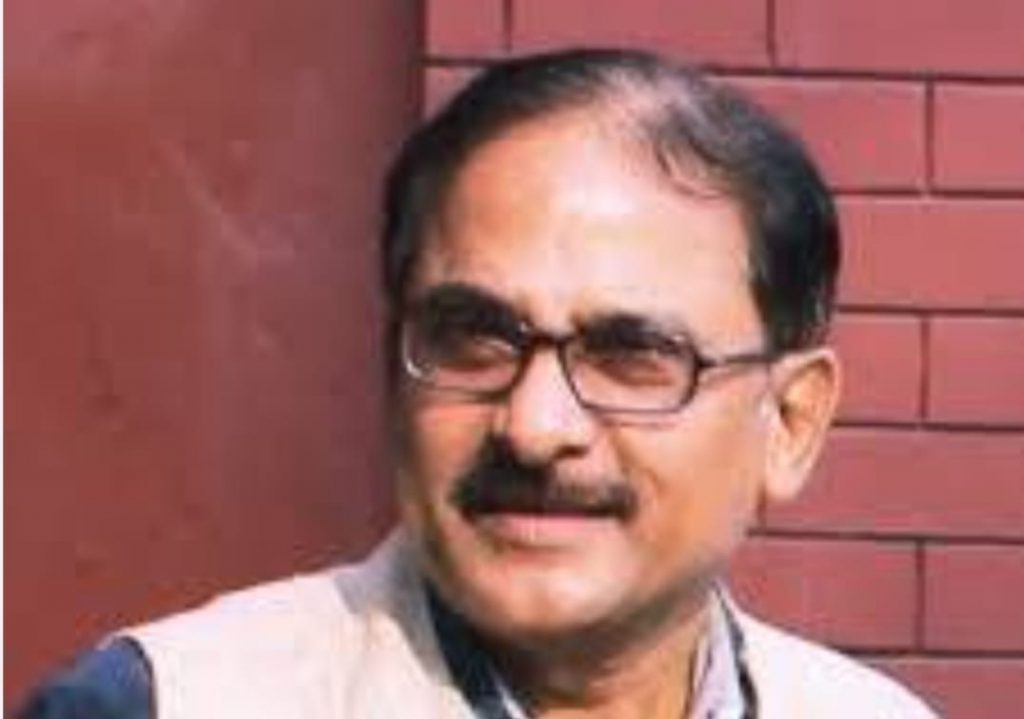
Prof. Chandi Prasad Nanda
Universities occasionally encounter moments when history ceases to be a memory and becomes a horizon. Utkal University stands today at one such moment. Between the aspirations of Viksit Odisha 2036, our own Centenary in 2043 and the national imagination of Viksit Bharat 2047, we are not simply orienting ourselves towards three future horizons but entering into three overlapping conversations about the future of knowledge, society and humanity itself. Our Centenary, therefore, has already begun—not as a countdown to an anniversary, but as an ongoing intellectual project of institutional reinvention.
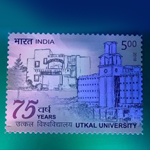
Founded in 1943 as Odisha’s first university, Utkal University belongs to one of the most remarkable moments in the making of modern Odisha. Its emergence coincided with the formative years of a newly constituted State and with the creation of Bhubaneswar as its new capital—a city imaginatively conceived to bring into creative dialogue the civilisational depth of the historic Temple City with the aspirations of a modern, forward-looking Odisha. In many ways, the University and the Capital became companion institutions in shaping the intellectual destiny of the new State. That founding imagination continues to inspire us. Our responsibility today is to extend that conversation into the twenty-first century by creating new intersections between history and innovation, heritage and technology, scholarship and society, and knowledge with public purpose.
Across our 458-acre campus, we are seeking to cultivate the University as a living knowledge ecology rather than merely an academic estate. This calls for what we describe as the ecological curation of nature—not as an exercise in landscape management, but as an intellectual commitment to reimagining the relationship between technology, ecology and human futures. Here, laboratories increasingly converse with landscapes; artificial intelligence with ethics; innovation with inclusion; entrepreneurship with ecological responsibility; and disciplinary excellence with transdisciplinary imagination. The campus itself is envisioned as an evolving ecology of learning where scientific inquiry, entrepreneurial imagination and ecological responsibility continuously co-produce one another. Within this larger ecology, we are nurturing a new regime of research distinguished by translational inquiry, patents, university-industry collaborations, innovation and incubation ecosystems, frontier research, start-up cultures and knowledge capable of generating enduring public value.
This transformation is not being pursued through isolated initiatives but through a new institutional grammar. Cutting-edge academic programmes, frontier disciplinary engagements, digitally intelligent governance, global academic partnerships, community outreach, social engagement and expanding knowledge networks are gradually being woven into a coherent architecture of institutional purpose. The significance of these initiatives lies not in their individual visibility but in their cumulative capacity to reshape how a public university thinks, learns, collaborates and contributes to society.
We equally believe that the university of the twenty-first century must recover its deeper public vocation. Its measure cannot finally be determined by rankings alone, nor by publications, patents or employability in isolation. It must also be judged by its capacity to enlarge democratic reason, deepen social trust, generate sustainable futures and produce knowledge that remains intellectually rigorous while being publicly consequential. Knowledge realises its fullest meaning when it circulates beyond the university even as it continues to renew the university itself.
Our location in Odisha is therefore, not a geographical circumstance but an epistemic advantage. Few regions bring into such intimate conversation between classical civilisation, maritime heritage, tribal knowledge systems, ecological diversity, mineral economies and rapidly transforming technological futures. Rather than treating these as separate domains, we seek to cultivate them as interconnected sites of inquiry, enabling Odisha itself to become one of the University’s most important laboratories for generating knowledge of both regional relevance and global significance.
As we journey towards 2036, 2043 and 2047, our aspiration is not simply to become a globally recognised university. It is to become a university that is globally recognised because it contributes distinctive ideas, exemplary practices and transformative institutional models to the wider world. Universities acquire enduring visibility not merely by participating in global conversations, but by helping redefine them. That is the intellectual journey upon which Utkal University has consciously embarked.
I warmly welcome students, scholars, researchers, alumni, policymakers, industry leaders, institutions and communities across the world to become fellow travellers in this shared endeavour. Together, let us imagine, create and nurture a university that remains deeply rooted in Odisha while speaking with confidence to the wider world.
As we move forward, our endeavour is to transform inheritance into imagination, learning into leadership, knowledge into public purpose, and aspiration into collective achievement. This is the spirit that animates our journey—from Legacy to Leadership, from Learning to Transformation, and from Today to Tomorrow.
Welcome to Utkal University—where history becomes horizon, knowledge becomes responsibility, and imagination becomes institution.
Utkal University
Sculpting Hearts, Heads, and Hands—across the past, the present, and the future.
vc[at]utkaluniversity[dot]ac[dot]in
Vice Chancellor, Utkal University